
Rodent Control for Mice and Rats at Smith Mountain Lake
You open the lake house for the weekend and find droppings on the counter, a chewed seat cushion or a nest of shredded paper towels in a drawer. That is when people call us for rodent control at Smith Mountain Lake.
Moorman’s Wildlife Management & Pest Control covers lake homes from our base in Hardy. Call (540) 494-8278. We find how the mice or rats are getting in, deal with the ones inside and seal the house to help keep rodents out between your trips.
- Office617 Middle Valley Rd, Hardy, Virginia
- Phone(540) 494-8278
- Service areaSouthwest Virginia, including Roanoke, Lynchburg and Smith Mountain Lake
What Rodent Activity Looks Like at a Lake Home
- Droppings in kitchen cabinets, drawers, the pantry or the garage when you arrive after an absence
- Chewed cushions, mattresses, boat covers or stored bedding in a closet or boathouse
- Nests of shredded paper, insulation or fabric in a corner, under a sink or inside furniture
- Gnawed food packaging, pet food or soap left in a seasonal kitchen
- Scratching in the walls at night, or a stale, musky smell when the house is first opened
Seasonal Homes and Rodents at the Lake
Mice and rats move indoors as nights cool in fall, and a lake house that is closed for the winter is an inviting target. Nothing disturbs them, and a few crumbs or a bag of birdseed left in a cabinet can feed a family through the cold months. A single pair can multiply quickly, so what starts as a few droppings in October can be a serious infestation by the time owners return in spring.
Lake properties add other hiding places. Boathouses, dock storage, detached garages, sheds and crawl spaces provide cover close to the water and woods, and wiring and cushions invite gnawing. Rodents also travel along dock lines, utility lines and fence rails. During an inspection we check the main house and every outbuilding, because sealing one structure while another stays open often just moves the problem. We also look for the entry route first, then place traps along it.
How Rodent Removal and Exclusion Works
We start by finding where the rodents are traveling and nesting, then place professional-grade traps along those routes and monitor until activity stops. Trapping handles the animals that are there now. Exclusion is the key follow-up step: once we confirm rodents are no longer using an opening, we seal the gaps around pipes, vents, doors, foundation seams and utility lines with gnaw-resistant materials, so rodents are not sealed inside. Mice need very little room, so we check carefully. Afterward we advise on removing droppings and nesting material, and replacing insulation or stored items that were contaminated.
Closing Up a Lake Home for the Season
A little preparation lowers the odds of finding a surprise in spring. Remove all food, including pet food, birdseed and pantry items that are not in sealed containers, and store bedding, cushions and boat covers in lidded plastic bins. Clear leaves and wood piles away from the foundation, and check that door sweeps and vent covers are intact. A visit by a neighbor or property manager every few weeks to look for droppings makes it easy to catch a problem early.
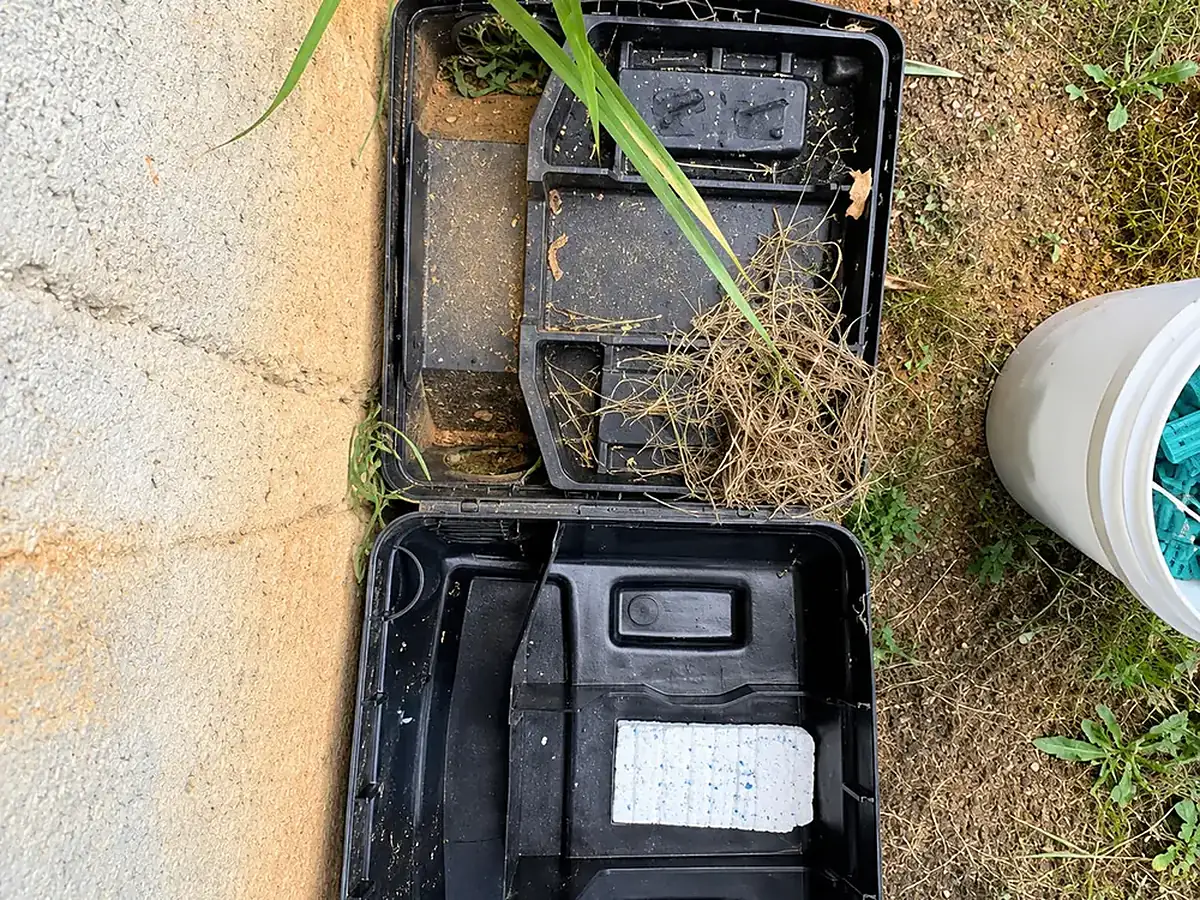
Rodent and Mouse Control Example
Rodent control equipment at a job site. What is used, and where, depends on the site, the species and the product label.
Rodent Control Service Areas Near Smith Mountain Lake
Our lake rodent service also covers Moneta and the Bedford County and Franklin County shores.
Mice and rats at Smith Mountain Lake: how we find them
The empty-house problem
Plenty of lake homes are weekend places or rentals. A house that sits quiet and dark for two or three weeks, with food in the pantry and soft bedding upstairs, gives mice everything they want and nobody to notice them. By the time someone opens the door, a few mice can have spread through the kitchen, closets and attic.
Fall is a common time for trouble. Cool weather pushes mice to seek out warmth and food, often just as lake houses are being closed for the season.
Signs we look for
- Droppings in drawers, on counters, under sinks and along baseboards
- Chewed food packaging, cushions, life jackets or stored linens
- Nests of shredded paper, fabric or insulation in closets, cabinets or the attic
- Scratching in walls at night when the house is occupied
- Burrows or runways along the foundation, under the deck or beside the boathouse
Where they get in on a lake house
A mouse can fit through a hole the width of a pencil. Lake houses add a few entry points most homes don’t have:
- Water, power and gas lines running under decks and into the foundation
- Walk-out basement doors and the gaps under them
- Crawl space vents on the downhill side of the house
- Garage and boathouse doors that no longer seal at the bottom
- Rafters, eaves and soffits on the tall lake side, where rodents climb in high
Sealing mice and rats out of Smith Mountain Lake homes
Mice chew through foam, plastic and wood, so sealing has to be tougher than that:
- Small holes: packed steel wool held in place with caulk
- Larger holes: hardware cloth or metal sheeting, cut to fit around pipes
- Crawl space vents: heavy metal screening
- Doors: new sweeps and bottom seals on basement, garage and boathouse doors
- Outbuildings: sheds and boathouses sealed too, so they don’t become a staging area for the house
Keep firewood stacked away from the house and off the ground, and trim shrubs back from the foundation so rodents have less cover.
Mice in a closed-up lake house? Ask for a visit
Found droppings when you opened the lake house? Tell us what you’re seeing and we’ll check the house and every outbuilding.
Questions we hear
Why do seasonal lake homes get so many mice?
They are quiet for long periods, so mice can nest and breed undisturbed. Leftover food in cabinets and soft furnishings for nesting make them even more attractive.
Can rodents damage a boathouse or dock storage?
Yes. They chew rope, cushions, boat covers and wiring, and nest in stored gear. Boathouses and outbuildings should be inspected along with the main house.
What is the best way to keep mice out while the house is empty?
Seal exterior gaps, store food in sealed containers or remove it, and keep vegetation away from the foundation. A professional exclusion can help close entry points, once any rodents inside have been dealt with.
Is it safe to open a lake house that had a mouse problem?
Before cleaning a closed lake house or outbuilding, open doors and windows for 30 minutes and leave the area while it airs out. Do not sweep or vacuum rodent urine, droppings or nests. Heavy contamination or contaminated insulation needs additional precautions and professional assessment. A basic mask is not a substitute for the respiratory protection required for heavy infestations. Contact us before disturbing heavily contaminated areas.
Do you also handle rodents under docks or in outbuildings?
Yes. We inspect the main house, garage, shed, boathouse and any other structure that offers shelter to rodents.
How much does rodent control cost at Smith Mountain Lake?
It depends on the size of the property and how many structures need sealing. A house alone is quicker than a house, garage and boathouse together. The number of entry points sets the quote.
Can mice live in my boathouse?
Yes. Boathouses have storage lofts, boat covers and soft gear that rodents use for nesting, and few visitors to disturb them. Sealing the bottom of the doors and any gaps at the eaves helps.
Can mice find a new way into my lake house later?
Sealed gaps are hard for mice to reopen, but new openings can appear when a deck is rebuilt or a new line is run to the dock, so check for fresh droppings each time you open the house.
Is lake house rodent work safe for my kids and pets?
Ask what we plan to use inside the lake house before work starts. Keep children and pets away from droppings, and air out a closed house before anyone cleans.
Send us the details
Thank you, we have your request
We will call or write back to set up your inspection. If it cannot wait, call (540) 494-8278.
Find us on Google Maps
Moorman’s Wildlife Management & Pest Control
617 Middle Valley Rd, Hardy, VA 24101
(540) 494-8278