
Starling Removal for Southwest Virginia Homes
Loud chattering inside a bathroom fan, straw poking out of a dryer vent or a flock leaving white streaks down the siding are all good reasons to look into starling removal. Moorman’s Wildlife Management & Pest Control clears starlings out of vents, eaves, gutters and roof gaps on homes across Roanoke, Smith Mountain Lake, Lynchburg and the New River Valley. Call (540) 494-8278 and we’ll confirm the bird, clear the nest the right way and cover the opening so the next pair can’t use it.
Pascat photo request
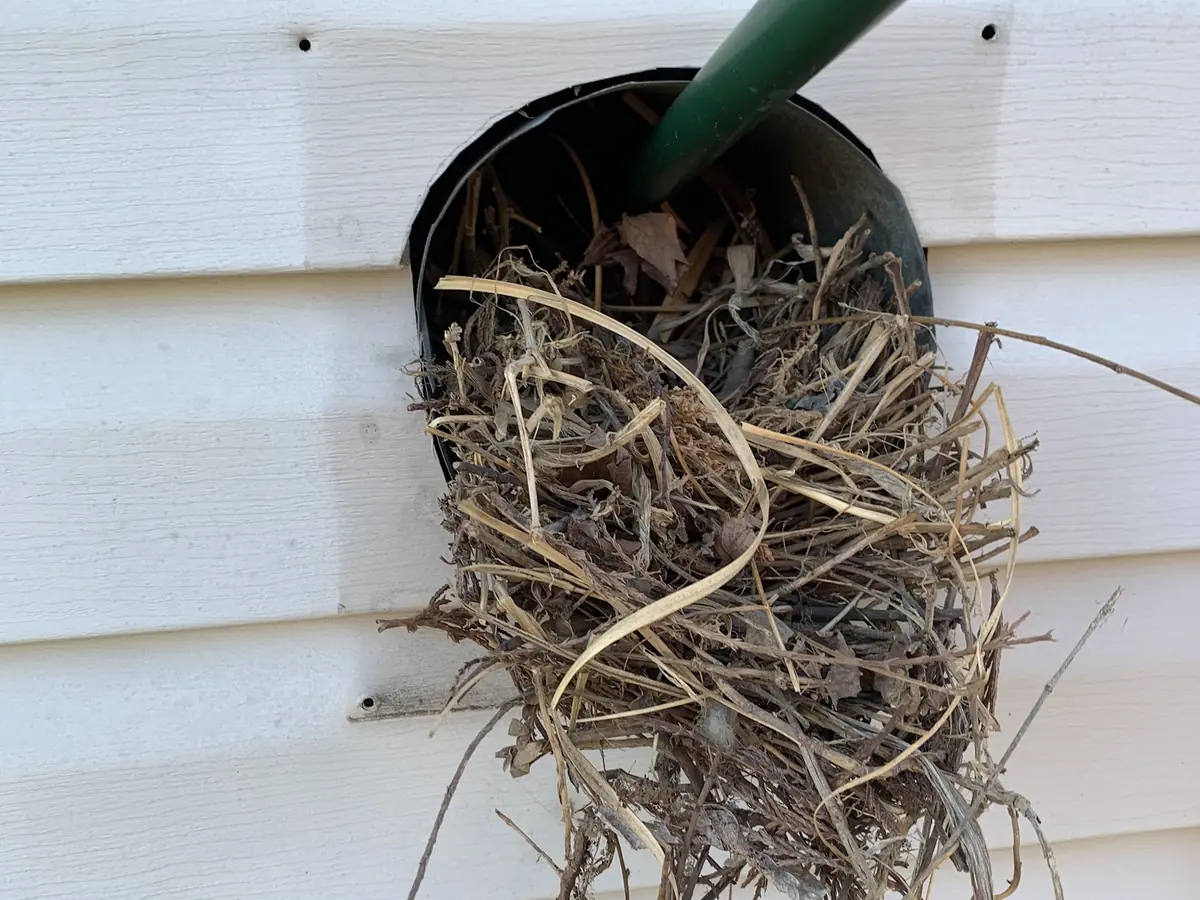
A close photo of an active starling nest packed into a dryer vent, soffit or gable vent, with the vent and nest material visible.
- Office617 Middle Valley Rd, Hardy, Virginia
- Phone(540) 494-8278
- Service areaSouthwest Virginia, including Roanoke, Lynchburg and Smith Mountain Lake
Why Starlings Cause Problems
European starlings are not native to North America. They were brought over from Europe in the late 1800s and have since spread across the continent, living comfortably in towns, farms and open country.
They nest in cavities, which is why they target vents, soffits and chimneys. They gather in large, noisy flocks, and they can compete with native cavity nesters such as bluebirds and woodpeckers for nest sites.
Health Risks and Property Damage
Bird droppings can carry fungi and bacteria. Histoplasmosis, a lung infection linked to a fungus that can grow in soil or material enriched by bird droppings, and salmonella are among the concerns. If you are worried about exposure, talk with your doctor or local health department. Droppings should not be swept dry, because that puts dust in the air.
Nests are a structural issue too. Starling nests can block a chimney flue, a dryer vent or an attic vent, which can create a fire risk, trap exhaust and cut down airflow. Droppings stain siding, statues and equipment, and over time they can damage metal and stone.
Signs of Possible Starling Activity
- Noise: chirping, fluttering and scratching from the attic, walls or chimney, often in early morning or evening
- Droppings: white streaking or heavy buildup near vents, chimneys and rooflines
- Nest material: twigs, leaves, grass or feathers around vents, soffits or inside a chimney
- Blocked ventilation: weak airflow from a vent or a chimney that no longer draws properly
- Birds going in and out: small dark birds repeatedly entering the same opening
These signs can also come from other birds or animals. Noise, droppings, nest material or eggs alone do not confirm starlings, so the species is identified at inspection before any work begins.
Starlings and the Law
Many birds that look similar from a distance, such as grackles and other blackbirds, are protected. For that reason we identify the species before any work begins, and we carry out any removal in accordance with Virginia regulations. If you are not sure what is nesting in your vent, do not remove the nest yourself, because it may belong to a protected species or hold eggs or young.
Exclusion with Netting and Sealing
Once we have confirmed the birds are out and no eggs or young remain, the opening has to be closed, or another pair may move in. Depending on the building, we use bird netting, vent covers and sealing to shut the openings starlings use.
Netting is low-profile from the ground and, when fitted properly, can be a good fit for open areas under eaves and around rooflines. For a wider look at deterrents, see our bird control page.
Cleanup After Starlings
Nesting material and droppings do not leave with the birds. If starlings have been in an attic, soffit or vent, we remove the nests and droppings, clean the area and, when needed, replace insulation that has been soiled.
Cleanup is done with protective gear and with care to avoid stirring up dust. For heavier contamination, see our attic restoration service.
Examples of Bird Nest Sites
General examples: a bird nest with eggs inside a gutter (left) and a bird nest packed into a siding vent (right). Nests and eggs alone do not identify the bird species.
Pascat photo request
A close photo of an active starling nest in a gutter or vent, with the bird or the nest material identifiable, taken from a ladder.
Starling Removal Service Areas
Roanoke · Lynchburg · Blacksburg · Martinsville · Lexington · Smith Mountain Lake · and surrounding communities
Signs you need starling removal
European starlings are stocky, short-tailed birds about 8 1/2 inches long. From a distance they look black, but up close the feathers are a glossy greenish black, speckled with white in fall and winter.
You likely have a starling problem if you notice:
- Birds flying straight into a vent hood, soffit gap or gutter end several times an hour
- Grass, pine needles, feathers or string sticking out of an opening
- Scratching, flapping or loud begging calls inside a wall, fan duct or dryer line
- A crowd of noisy birds on the roof or in a nearby tree every evening
- Droppings streaking siding, decks, cars or a pool below the nest
Want more detail on where nests show up? Our guide to starling nests in vents, chimneys and soffits walks through each spot.
Why starlings are worth removing
Nests block vents
A starling nest is a bulky pile of dry grass and debris packed into a cavity. In a dryer vent that pile blocks airflow, and lint that builds up in a blocked dryer line is a fire risk. In a bathroom or range hood vent it stops the fan from doing its job.
They return and raise more young
Starlings can raise one or two broods in a season, and an opening that worked once tends to get used again.
Mess and health concerns
Nesting birds drop waste into pools and birdbaths, and roosting flocks whitewash buildings. We treat a heavy droppings buildup as a cleanup job, not a hose-off.
They push out native birds
Starlings take over nest cavities and drive away bluebirds, purple martins and other native birds. Taking back the gaps on your house helps the birds you want to see.
How our starling removal works
1. Find every opening
We check vent hoods, soffits, fascia gaps, roof returns, gutter ends, chimney tops and any loose siding. A flock rarely settles for one hole, so we look at the whole roofline.
2. Clear the nest
Once we know the opening is in use, we remove the nesting material from the vent or cavity.
3. Make sure no bird is trapped inside
Before sealing, we confirm the opening is empty so no bird is closed into a wall or duct.
4. Cover the opening with the right part
Any opening we leave, such as a vent slot, ends up narrower than 1 1/8 inches, which keeps starlings out. We use durable materials like metal flashing, wood and sturdy mesh, since window screen tears too easily.
- Passive vents such as gable or soffit vents get heavy 1/4-inch hardware cloth behind them.
- Dryer vents are never screened over, because trapped lint can start a fire. They get a cover that lets air out but keeps birds from getting in.
- Roof gaps and soffits are repaired and closed as part of roofline protection.
5. Clean up
We remove nest debris and droppings from the work area. Larger buildups on a business are covered by our bird droppings cleanup service.
Keeping starlings from coming back
Starlings are easiest to stop before they settle. Once a flock is used to a spot, scare tactics usually work for only a few days or weeks before the birds ignore them.
- Close vent and soffit gaps before the birds start nesting, not after
- Keep birdhouse holes smaller than 1 1/8 inches so starlings can’t use them
- Bring suet feeders in if starlings crowd out other birds
- Keep trash bags inside closed cans so flocks can’t rip them open
Storefronts, barns and warehouses with roosting flocks need a bigger plan. See commercial bird control.
Questions we hear
Are starlings protected?
No. European starlings are non-native and are not protected the way native birds are, but some look-alike birds are, so we confirm the species first.
How do starlings get into a house?
They look for any covered gap that leads to a sheltered space. Common entry points are attic and gable vents, dryer vents, damaged soffits and fascia, open chimneys and gaps where the roof meets the wall.
Could the noise in my attic be something other than starlings?
It could. Squirrels, mice, raccoons and bats also make sounds in attics. Starlings tend to be noisy in the early morning and evening and are often seen flying into one opening. An inspection helps confirm it, since each animal calls for a different fix.
What health risks come with starlings?
Their droppings can carry fungi and bacteria, including the fungus linked to histoplasmosis, and salmonella. The risk can increase when dried droppings are disturbed, so leave heavy buildup for a professional to clean.
How do I keep starlings from coming back?
Once the birds are confirmed out, close every opening they used. Netting, vent covers and sealed gaps help reduce the chance of birds returning. Removing birds without closing the opening often means another pair finds it by the next nesting season. Openings should not be closed while birds, eggs or young may still be inside.
How much does starling removal cost?
Most of the price comes from the number of openings and how high they are. A single low vent costs far less than a full roofline with several nests, so we count the openings before giving you a number.
Will starlings try to nest in the same vent again?
They will try, because starlings return to good nest sites. With every opening closed with hardware cloth or metal and vents fitted with bird-proof covers, they have no cavity left to build in.
Is starling removal safe for my kids and pets?
Yes. Keep kids and pets away from the work area while we clear nests and clean droppings. Vent covers and mesh are permanent parts that don’t use chemicals.
Related Guides
Request an inspection
Request a Starling Inspection
Hearing birds in the attic or seeing droppings around a vent? Schedule an inspection and we will find the entry point, confirm which bird is using it and talk through removal and exclusion options.
Send us the details
Thank you, we have your request
We will call or write back to set up your inspection. If it cannot wait, call (540) 494-8278.
Find us on Google Maps
Moorman’s Wildlife Management & Pest Control
617 Middle Valley Rd, Hardy, VA 24101
(540) 494-8278