
Raccoons in Virginia: Identification, Signs and Seasons
Heavy thumping in the attic at night or a torn-up corner of the roofline is how many homeowners first learn that raccoons in Virginia have picked their house for a den. A raccoon looking for a den can do real damage on its way in.
This guide covers how to identify raccoons, what their signs mean and the health risks that come with them. If you suspect one is living in your home, call Moorman’s Wildlife Management & Pest Control at (540) 494-8278 or request an inspection.
For the service itself, see our raccoon removal page.
At a glance
- Type: Mammal
- Common VA species: Common raccoon (Procyon lotor)
- Size: Roughly 10 to 25 lb; about 28 in. long (sizes vary)
- Color: Grizzled gray-brown, black face mask, ringed tail
- Active season: Year-round (most active spring)
- Where found: Attics, chimneys, crawl spaces
- Main problem: Structural damage, contamination, roundworm risk
- Litters per year: Typically one litter a year, born in spring
- Entry gap needed: About 3 to 4 inches or larger; varies
Is it a raccoon in the attic?
Raccoons can carry rabies and raccoon roundworm, and a mother with young in an attic or chimney requires removal planned so that young are not separated from her or trapped inside. Loud nighttime noises overhead and torn roofline or soffit areas can be signs of a raccoon entry, but noise alone does not identify the animal.
How to Identify Raccoon Activity
Opening size and damage pattern can help, but they do not settle the question. Openings of about 3 to 4 inches or larger can let a raccoon in, and raccoons tend to pull or tear materials apart rather than gnaw small holes. Pulled-back shingles, ripped soffit, and a roofline hole with claw marks around the edge can suggest raccoons rather than squirrels or bats, but squirrels can enlarge holes by chewing and animals can reuse existing openings. An inspection should confirm the animal, the entry point and whether young are present before anything is sealed.
Raccoons are often loud and heavy overhead, usually at night, while squirrel noise is often lighter scampering, but sound alone does not identify the animal.
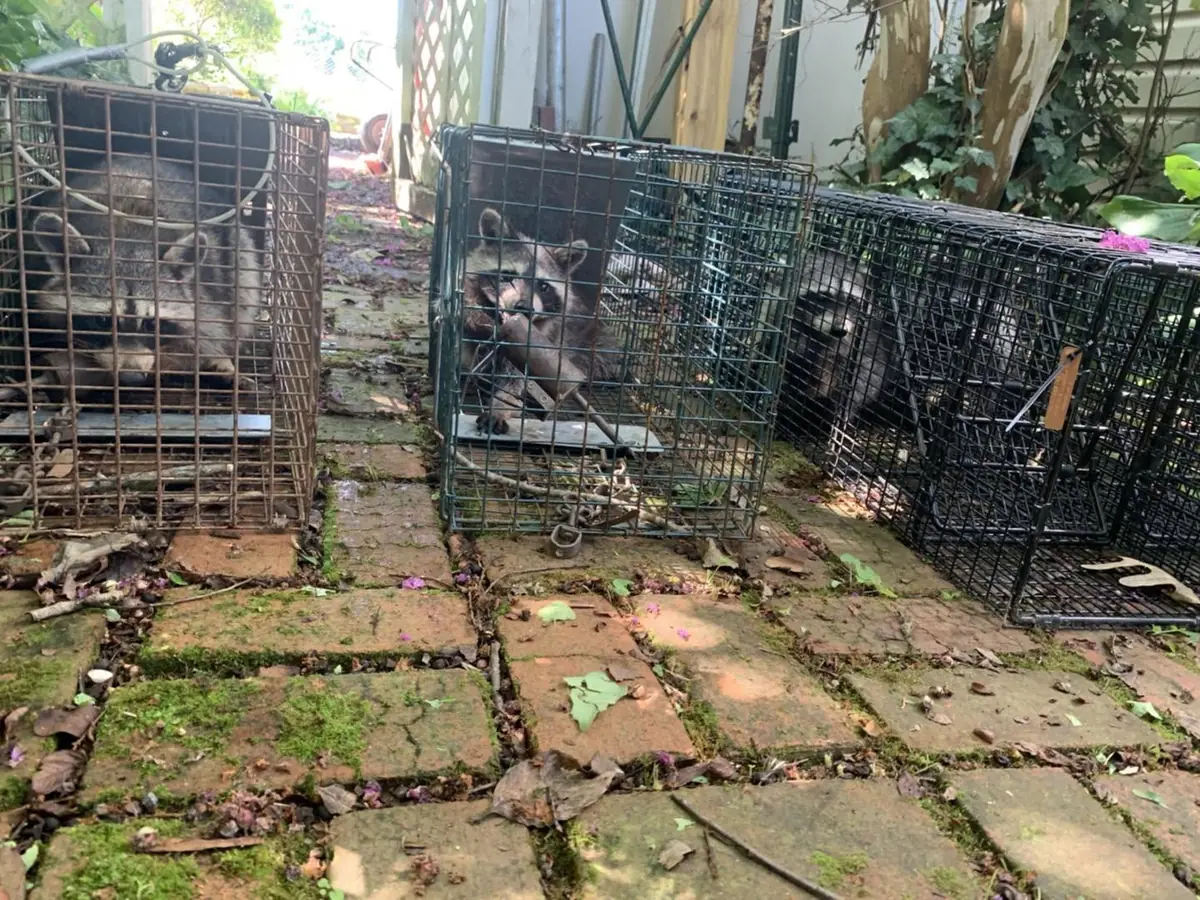
Common Signs of Activity
- Heavy thumping or walking sounds in the attic at night
- Torn shingles, ripped soffit, or a roofline hole with claw marks around the edge
- A latrine: a concentrated pile of droppings in one spot in the attic or on a flat roof section
- Strong, persistent odor from urine and droppings
- Chimney sounds in spring, which may mean a female with kits in the flue
- Overturned trash cans or damaged garden areas outside
Where Raccoons Are Commonly Found
Attics reached via roofline damage, uncapped or poorly capped chimneys, crawl spaces, and spaces under decks and sheds. A female raccoon looking for a den site in spring may test roof edges, chimney flues and vents until she finds a weak point, and an uncapped or poorly capped chimney is a common spring den site.
Life Cycle, Behavior, and Seasonality
Raccoons breed in late winter, and females may den in structures to raise kits, which are usually born in April or May. Kits depend completely on the mother for about 8 to 10 weeks, which matters for exclusion timing: sealing a female out during this window can trap kits inside or lead her to tear open a new opening.
| Jan to Mar | Breeding season; females seek den sites |
|---|---|
| Apr to May | Kits born in a den and nursing, immobile |
| Jun to Jul | Kits begin to move about but are still dependent on the mother |
| Aug to Sep | Juveniles weaned and beginning to forage independently |
| Oct to Dec | Family group disperses; activity generally decreases |
Health and Safety Considerations
Rabies. Raccoons are a recognized rabies vector species in Virginia. Do not handle a raccoon, and treat any bite, scratch or uncertain contact seriously. Contact your doctor and the local health department.
Structural. Torn roofline materials, compressed and contaminated insulation, and chewed or torn ductwork are common findings after a raccoon den is vacated.
What Property Owners Can Do
- Keep trash cans secured with locking lids: raccoons are highly food-motivated
- Have chimneys capped, especially before spring denning season
- Trim tree limbs away from the roofline to reduce roof access
- Repair roofline damage promptly before it becomes an entry point
- Do not seal an active den until it is confirmed that no kits are present and any adult has left
- Do not attempt to handle or move a raccoon yourself
When Professional Service Is Appropriate
Signs of raccoons in your home
In the attic
- Heavy walking or thumping after dark, since raccoons do most of their moving at night
- A pile of dark droppings in one spot, which is a latrine
- Insulation or roofing torn loose around the opening they use
On the roof and walls
To reach an attic or wall space, raccoons will rip off shingles and pull loose fascia boards. Tree limbs hanging over the roof give them an easy route up.
In the chimney
An open chimney looks a lot like a hollow tree to a raccoon, which makes an uncapped flue a natural den. Scratching or movement inside the flue is the usual clue.
Around the yard
Tipped trash cans, raided pet food and half-eaten sweet corn, tomatoes and melons in the garden all point to raccoons. Torn-up patches of sod can come from raccoons rolling back turf to hunt grubs.
Raccoon latrines and roundworm
Raccoons pick a few favorite spots to leave their droppings, called latrines. They show up at the base or fork of trees, on logs, woodpiles and large rocks, on decks and patios, and in attics and garages. The droppings are dark, tube-shaped and strong-smelling.
Raccoons are the main host of a roundworm whose eggs leave the body in their droppings. People get sick by swallowing the eggs, so young children who play in soil or put things in their mouths are at highest risk. The eggs need at least 2 to 4 weeks to become infectious, which is why cleaning a latrine quickly matters.
If you clean a small outdoor latrine yourself, wear disposable gloves and boots, use a shovel or an inside-out plastic bag and wash up well afterward. Most chemicals do not destroy the eggs. Attic latrines are a bigger job, and the soiled area needs careful handling; see attic restoration.
How we handle raccoons
When a raccoon is denning in an attic or chimney near Hardy, Roanoke or the lake, we first check whether a mother has young inside.
What affects the cost
- Where the raccoon is living: attic, chimney, wall or under a deck
- Whether a litter of young is present
- The amount of fascia, soffit or vent damage at the entry point to repair
- How large the latrine area is and what it has soiled
Related Projects and Guides
Request an inspection
Think You Have Raccoons?
An inspection can help identify what is behind raccoon activity and the options for dealing with it.
Send us the details
Thank you, we have your request
We will call or write back to set up your inspection. If it cannot wait, call (540) 494-8278.