
Snakes in Virginia: Identification, Safety and Look-Alikes
Coming face to face with a snake on the porch steps is unsettling, but most snakes in Virginia are harmless and many help by eating rodents. Only three of the state’s snakes are venomous, and just one is common in most of our service area. If a snake is inside your home or you are not sure what it is, keep your distance and phone Moorman’s Wildlife Management & Pest Control at (540) 494-8278, or request an inspection.
This guide helps you recognize the snakes you are likely to meet, tell a copperhead from its look-alikes and keep snakes from moving in.
Need a snake taken out of the house now? See our snake removal page.
At a glance
- Type: Reptile
- Common VA species: Eastern rat snake, black racer, garter snake, copperhead, timber rattlesnake
- Size: Varies widely, 1 to 6 ft depending on species
- Color: Species-dependent
- Active season: Apr to Oct (dormant in cold months)
- Where found: Foundations, woodpiles, crawl spaces
- Main problem: Presence near living areas; venomous-species risk
- Litters per year: Varies by species
- Entry gap needed: Under 1/2 inch for small species
Is it venomous? Copperhead or harmless look-alike
Most snakes found around Virginia homes are non-venomous and can help reduce rodent populations, but correct identification matters before deciding what to do. Do not handle any snake, and treat identification as uncertain unless it has been confirmed. The safest choice is to keep your distance and call a professional rather than attempting to handle or remove it yourself.
How to Identify a Snake Problem
Virginia has a small number of venomous snakes, including the copperhead and, in parts of the state, the timber rattlesnake. Non-venomous snakes such as rat snakes and black racers are far more common around homes and are often mistaken for something more dangerous. Copperheads and timber rattlesnakes look different from each other, and no single pattern, pupil shape or head shape is a reliable test for a homeowner to tell venomous from non-venomous snakes. Species identification should be treated as uncertain unless a trained person has confirmed it.
Whenever identification is uncertain, treat the snake as potentially venomous, stay well back, and do not handle, corner or try to kill it. Getting close to check its markings is not a safe test.
Common Signs of Activity
- A snake seen in or around a foundation, woodpile, garden or crawl space
- Shed snake skin near a foundation, deck or crawl space entrance
- Rodent activity nearby (snakes may follow their food source)
- A snake found inside a garage, basement or crawl space
Where Snakes Are Commonly Found
Foundations, woodpiles, dense ground cover, gardens, and crawl spaces, especially where rodent activity provides a food source. A snake near a home can sometimes be a sign of rodent activity, but snakes also use cover, shade, water and warmth, so rodents are not always the reason.
Life Cycle, Behavior, and Seasonality
Virginia snakes are most active in warm months and enter a dormant state (brumation) during cold weather, and some snakes shelter together over winter in rock crevices and other protected spots. A snake found in a basement or crawl space in winter is worth having looked at.
| Time of year | What happens |
|---|---|
| Apr to May | Emerge from brumation; increased movement and mating activity |
| Jun to Aug | Peak activity; copperheads give birth from mid-August to early October |
| Sep to Oct | Preparing for brumation; movement toward denning sites |
| Nov to Mar | Brumation: largely inactive |
Health and Safety Considerations
Non-venomous species like rat snakes and black racers pose no venom risk and are often beneficial, since many eat rodents, but they can still bite defensively if handled, and their presence near a home can prompt a look at what’s attracting them.
What Property Owners Can Do
- Keep grass cut short and remove brush piles and dense ground cover near the foundation
- Address rodent activity, since snakes may follow their food source
- Seal foundation gaps and crawl space openings
- Keep woodpiles elevated and away from the structure
- Do not handle or try to kill any snake, and treat identification as uncertain unless a trained person has confirmed it
When Professional Service Is Appropriate
Identification and removal help for venomous and non-venomous snakes.
Snake Removal
Rodent Control
Addressing the rodent activity that may draw snakes onto a property.
How to identify a copperhead
- Pattern: dark hourglass crossbands that are broad low on the body and pinch in at the spine; some bands are broken
- Young: a bright sulfur-yellow tail tip that fades with age
Even the crossband pattern is not a reliable test on its own, and several harmless snakes look similar. Copperheads are generally calm and bite mostly when stepped on or threatened, so the best rule is simple: keep your space and treat any unidentified snake as potentially venomous.
Harmless snakes often mistaken for copperheads
- Young eastern ratsnake: gray or brown blotches on a pale gray background that do not reach down the sides; turns solid black as it grows
- Northern watersnake: brown or reddish bands that are broad at the backbone and thin toward the belly, the opposite of a copperhead; found near water
- Northern black racer: born blotched but usually solid black within about two years
- Eastern hog-nosed snake: an upturned snout; puffs up, hisses and may play dead
For copperhead problems at home, see copperhead removal.
The black rat snake
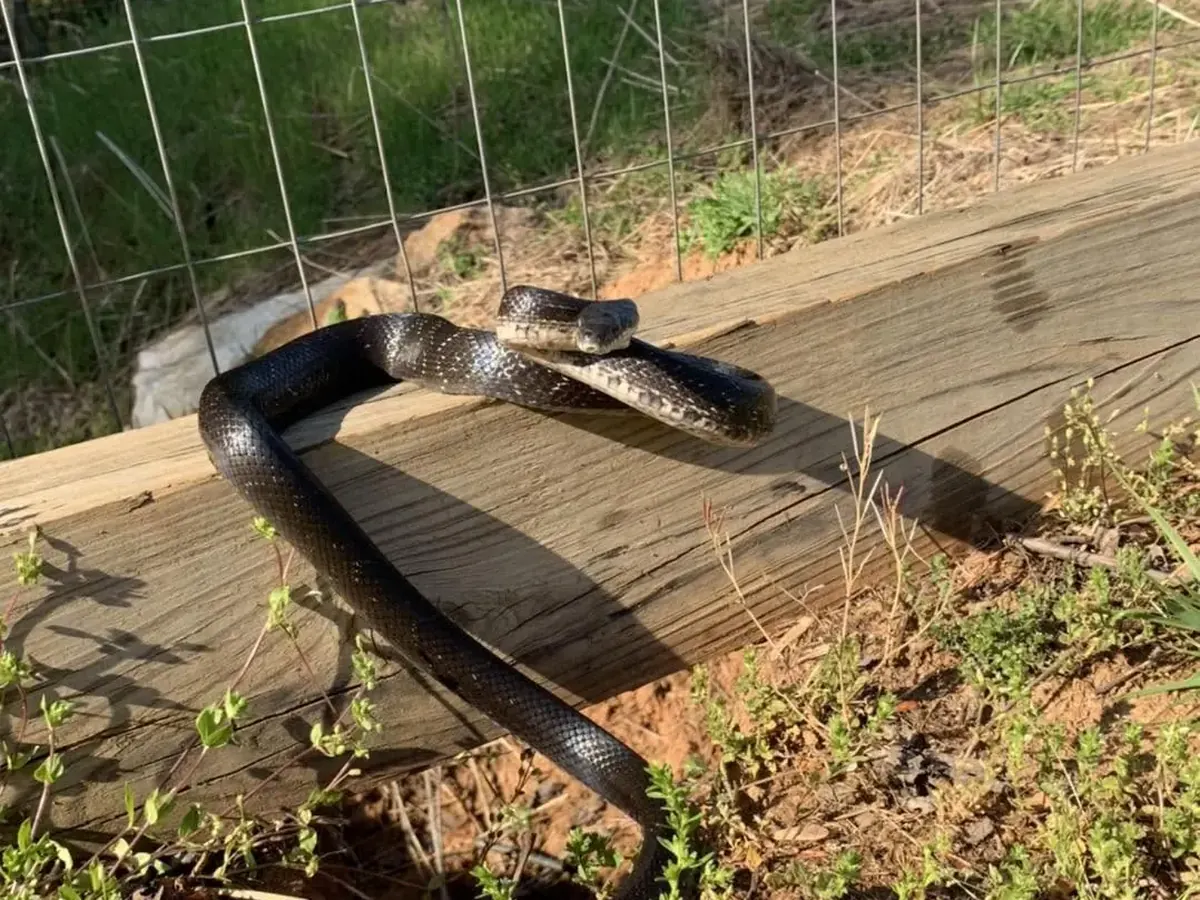
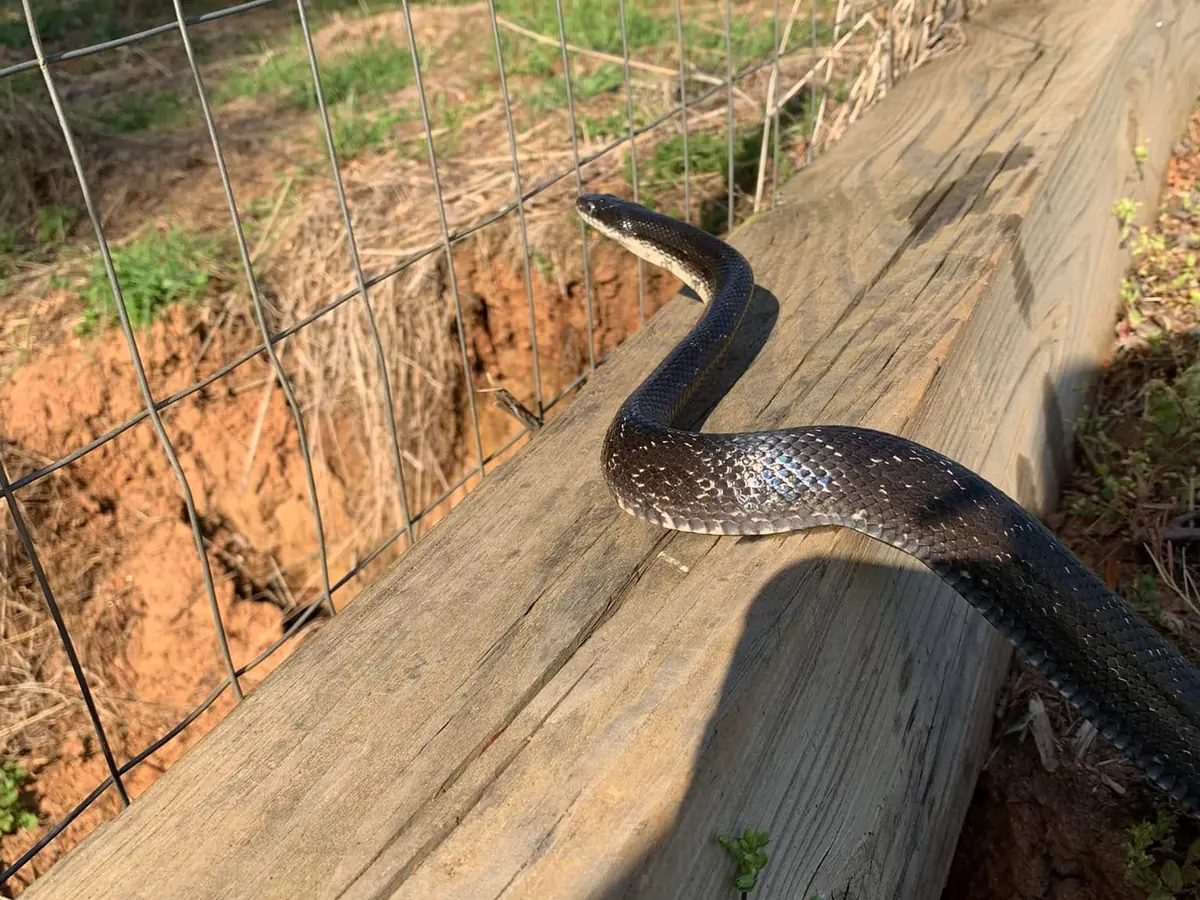
The snake people find most often in barns, sheds and garages is the eastern ratsnake, still widely called the black rat snake.
- Adults are solid black on top with a black-and-white checkered belly
- Usual length is about 3.5 to 6 feet
- It climbs very well, hunting birds and eggs in trees
- It eats mostly rodents, birds and eggs, so it shows up where mice and rats are plentiful
It is harmless to people and would rather escape than fight. When cornered, it may flatten its head, coil, hiss loudly and strike as a bluff. If one has settled in a building, see black rat snake removal.
Why snakes come around houses
A snake near the house is usually following food or cover. Common draws include:
- Rodents. A snake in the garage or basement often means mice or rats live there too. Our rodent control page covers that side of the problem.
- Cover. Rock piles, brush piles, stacked lumber and tall grass give snakes places to hide and hunt.
- Openings. Gaps around pipes, vents and foundation cracks let snakes into crawl spaces and basements.
- Overhanging plants. Snakes climb, so overhanging limbs and vines give them a route up to attic openings.
How we handle snakes
When a snake is inside a home, garage or crawl space near Hardy, Roanoke or the lake, we identify the species, remove it and then look for the gap it used. Sealing those openings, and dealing with any rodents that drew it in, is what keeps the next snake out.
What affects the cost
- Whether the snake is venomous
- Where it is: living space, basement, crawl space, attic or outbuilding
- How many gaps need sealing afterward
- Whether a rodent problem needs attention too
Related Projects and Guides
Request an inspection
Think You Have Snakes?
An inspection can help identify what is behind snakes on the property and the options for dealing with it.
Send us the details
Thank you, we have your request
We will call or write back to set up your inspection. If it cannot wait, call (540) 494-8278.