
Bat removal and exclusion for Roanoke houses
You watched bats slip out from under the roof at dusk and want them gone. We work on houses in the city and in Cave Spring, Hollins and Vinton.
Moorman’s Wildlife Management & Pest Control finds the gaps the colony uses, lets the bats leave through one-way exits, seals the house and cleans up after them.
Local notes
- Dormers, deep eaves, tall brick chimneys and layers of trim in Old Southwest and Grandin Village
- Queen Anne, bungalow and Foursquare houses share the same weak spots
- Big brown and little brown bats are the two we expect in Roanoke houses
- MethodOne-way exits; bats leave on their own
- First visitInspection and a plain plan
- AreaRoanoke, Cave Spring, Hollins and Vinton
Signs of bats on a Roanoke house
- Dry, crumbly droppings on porch roofs, window sills or the ground beside a brick chimney
- Dark rub marks or staining where dormers, trim boards and rooflines meet
- Soft chittering in walls or ceilings just after sunset, common under tall attics
- Bats dropping out from behind fascia boards, shutters or loose siding on warm evenings
- A musty ammonia smell in upstairs rooms or closets near the attic hatch
- Droppings along the edges of a finished third-floor space or on the stairs up to it
- A single bat indoors, which does not by itself mean a colony
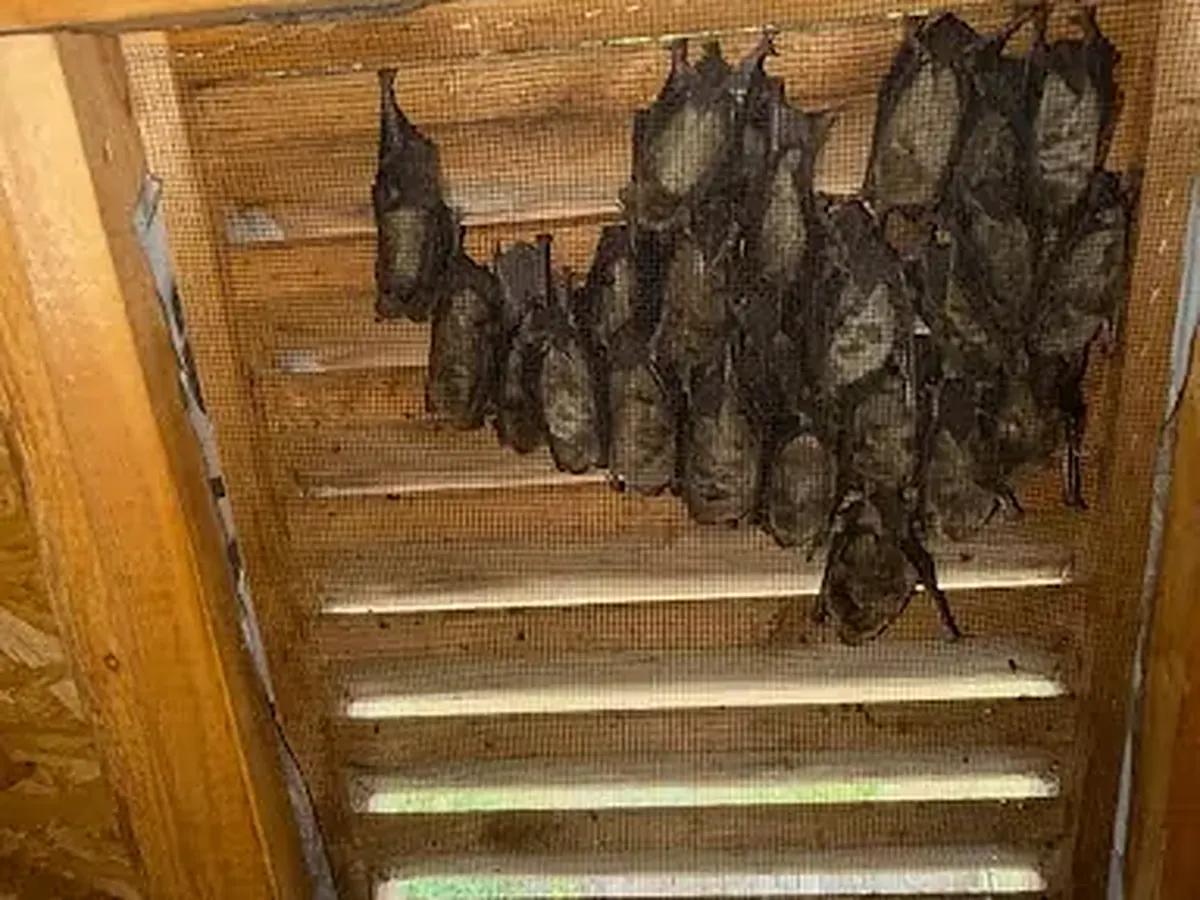
Dormers, turrets and chimneys in the older neighborhoods
A gap the width of your thumb behind a trim board can open into a large, warm void that holds a colony all summer. Old Southwest is full of Queen Anne houses, bungalows and Foursquares, and they share the weak spots we see across the older parts of the city: dormers and turrets where several roof planes meet, chimneys with loose flashing or crumbling mortar at the top, wood soffits and fascia that have shrunk or rotted, porch roofs tied into the main wall, and gable vents with torn or missing screens.
On newer houses in Cave Spring and Hollins we look harder at ridge vents, soffit returns and garage roof joints.
A first visit to a Roanoke house
Outside walk
The roofline, dormers, gables, soffits, chimney flashing and the joints where porches and additions meet the main roof.
Attic check
Droppings, staining and daylight showing through gaps. Houses with several additions or a finished attic room take longer, because each roof level and each old chimney is checked on its own.
Dusk watch, if needed
Watching the house at sunset shows exactly which gaps are live.
Species, young and plan
We note the kind of bat and whether pups are likely, then explain which gaps need work and when exclusion can start. More in what happens during a bat inspection.
Which bats, and what happens to them
Roanoke attics also host squirrels, mice and raccoons, so the inspection confirms the species before work is planned. Big browns often raise young in old houses and church steeples. Little brown bat numbers have fallen sharply because of white-nose syndrome, which is part of why timing and method matter.
Exclusion shuts the building to bats; it does not remove them from the neighborhood, and they keep feeding along the river, tree lines and slopes. From May through August the colony stays put and we use the time to plan. Once the roost is empty the devices come down and the last gaps close. Cleanup follows; see bat guano cleanup.
If a bat is loose in the house, start here. The main bat removal page has the method in full, and a past Roanoke bat exclusion is written up as an example.
Questions we hear
My house is in Old Southwest. Do older houses get bats more often?
They tend to offer more places to enter: separated trim, chimney flashing gaps, open eaves. That does not mean every old house has bats; an inspection shows which gaps are real entry points and which are only cosmetic.
Can bats get in through a chimney?
Yes. An open chimney or a gap around the flashing leads into the attic or even the living space. Once the bats are out we close those gaps.
Can you exclude the bats I hear in July?
Not in summer. Pups could still be in the roost and not yet flying, so we inspect now, plan the work and schedule the devices for after that window.
Will the bats disappear if I exclude them from my house near Mill Mountain or the river?
No. Exclusion only closes your building to them; they keep feeding outdoors and may look for other roosts.
Do you handle the attic damage too?
Both. After the bats have left and the openings are sealed we remove contaminated insulation, clean the area and advise on ventilation and prevention.
Can bats get back into an old house after sealing?
A bat shut out of one gap looks for another, so every gap gets closed. Older trim keeps aging, and a yearly look at the roofline catches new cracks.
Request an inspection
Bats in a Roanoke attic?
Tell us what you saw and when. We will look at the roofline and attic and explain what exclusion involves on your house.
Send us the details
Thank you, we have your request
We will call or write back to set up your inspection. If it cannot wait, call (540) 494-8278.
Find us on Google Maps
Moorman’s Wildlife Management & Pest Control
617 Middle Valley Rd, Hardy, VA 24101
(540) 494-8278