
Wildlife exclusion for Roanoke houses, starting at the chimney
Something keeps getting into your house and you want it to stop for more than a week. Exclusion means finding every opening, getting the animals out and closing those gaps so they cannot be used again.
Moorman’s Wildlife Management & Pest Control works in the city from Hardy, on century-old brick houses and newer split-levels alike. Call (540) 494-8278 and we go over the roof, chimney, siding and foundation, then explain what we found and how we will close it.
Local notes
- Old Southwest holds the city’s largest historic district, with turn-of-the-century houses under big street trees
- Raleigh Court, Grandin Court, Wasena and South Roanoke each have their own mix of house ages
- Mill Mountain rises in the middle of the city, and the Roanoke River Greenway threads green space through it
- SequenceWay out first, final seal last
- MaterialsMetal and mesh where animals chew
- AreaRoanoke, Salem and Vinton
Signs the house needs exclusion work
- Animals keep returning after an earlier trapping or removal visit
- A chimney with no cap, or a cap that is cracked, loose or bent
- Soffit panels sagging or pulling away from the fascia
- Dark rub marks or staining around a vent, corner or gap
- Gnawed corners on a soffit, or a roof vent with a hole in it
- Leaves and twigs stuffed into a gable louver or gutter end
- Bat droppings piled below a gap or stuck to the siding
- Vent covers that are bent, loose or missing, or a porch roof that no longer meets the wall tightly
The chimney comes first
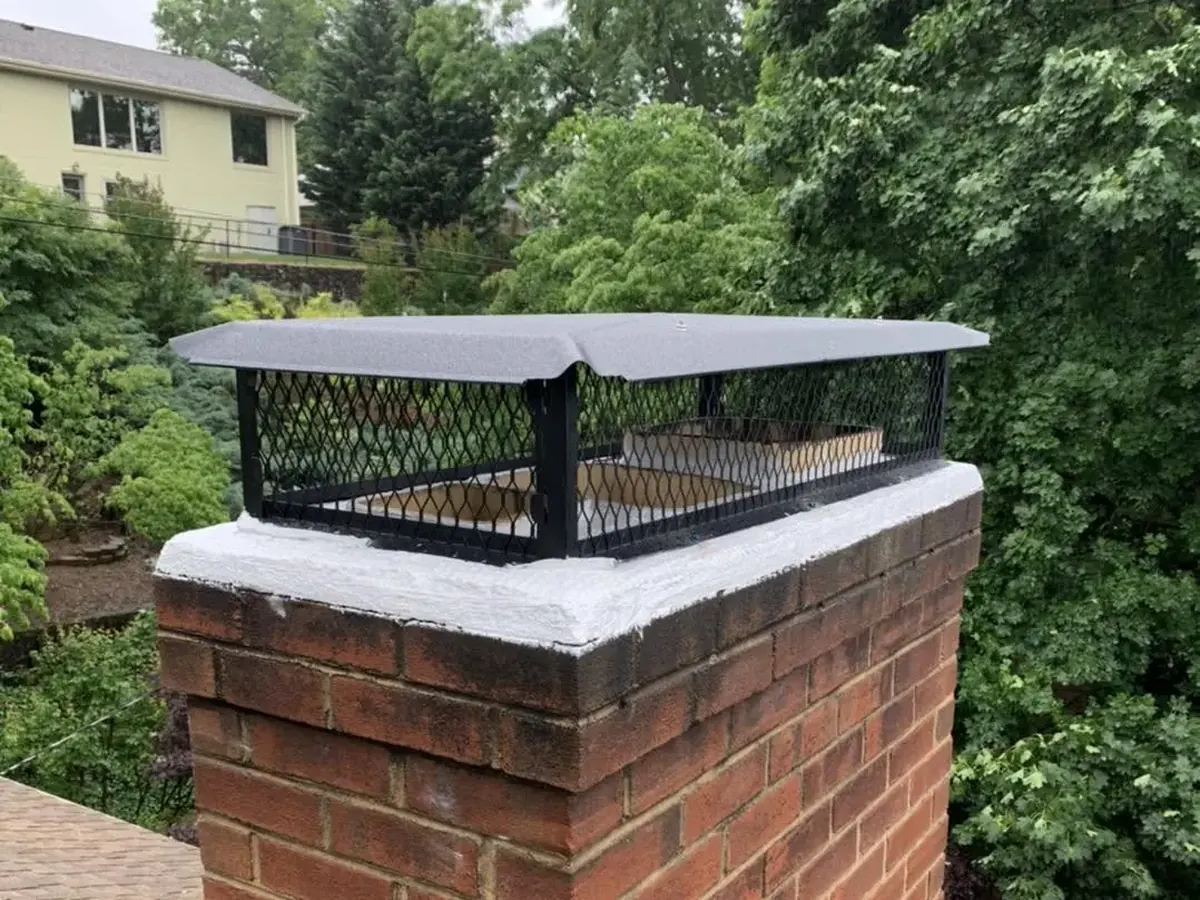
Many older houses here have a chimney, sometimes two, and some of those fireplaces have sat unused for years. An open flue is still an open door: raccoons den in them, squirrels drop into them, and birds and bats settle in. A fitted cap with sturdy mesh keeps animals out while letting smoke leave. If the crown or the mortar around the flue is cracked, that is repaired too, because a cap fastened to failing masonry will not stay put. Before any cap goes on we confirm the flue is empty of animals and young. See chimney cap installation.
What each era of house gives away
The weak points differ by age, and the plan matches materials to what is actually there. Older brick houses have wood cornices, box gutters, uncapped chimneys and attic louvers with no screen behind them. Mid-century houses have gable vents, carport and porch roof returns, and crawl spaces with worn vent screens. Newer construction has plastic roof vents, thin soffit panels and many gaps where utility lines enter.
Animals do not stay on the slope. They follow the river and cut through yards, and the first house with an open chimney or a loose vent cover is the one they remember, which is why exclusion is worth doing before a problem starts.
How an exclusion job runs
Map the openings
Rooflines, vents, chimneys, soffits and foundations are inspected. For each opening we identify the species, whether animals are inside and whether young may be present.
Give them a way out
If animals are inside and no young are found, a one-way device lets them leave while we close the unused gaps. The occupied entry stays open to the device until the space is confirmed clear.
Seal and reinforce
Once clear, the occupied entry is closed with wildlife-resistant materials, vent guards and exclusion barriers go on, and damaged soffits, fascia and roofline pieces are reinforced.
Final check
Every identified access point is re-inspected. Exclusion reduces repeat entry but cannot be guaranteed, so call if scratching, droppings or damage show up afterward.
Squirrels, bats, raccoons and mice
Squirrels chew in at soffit corners, roof returns and ridge vent ends, and on older houses a rotted cornice board is often the weak spot; see squirrel removal in Roanoke. Bats need only a narrow gap along the roofline and are never sealed out from May through August; see bat removal in Roanoke. Raccoons climb well and an open chimney makes a ready den; see raccoon removal in Roanoke. Rodents use the small gaps low on the house; see rodent control in Roanoke.
After the animals are out, rotted fascia, cornice and soffit boards are replaced so the seal holds; wildlife damage repair in Roanoke covers the larger repairs. For roof vent guards and soffit work, see roofline protection and entry point sealing.
Questions we hear
Why do animals keep coming back after a removal?
Removal alone leaves the opening in place. Animals that lose one door test the rest of the house, so every opening has to be found and closed.
Does a chimney cap stop smoke?
No. A fitted cap with sturdy mesh lets smoke leave and keeps animals out.
Is foam enough to seal a hole?
Foam and caulk alone rarely hold against teeth and claws. We use metal flashing, mesh and guards where animals chew.
Do newer houses need exclusion too?
Yes. Lightweight vents and thin soffit panels on newer houses can give way quickly, even though they have fewer joints than an older house.
What should I do around the house afterward?
Secure trash, remove food sources and trim vegetation back from rooflines and chimneys. It makes the property less appealing.
Is the work guaranteed?
Exclusion helps reduce repeat entry, but it cannot be guaranteed. If anything shows up afterward, call and we check the sealed areas.
Request an inspection
An animal getting into your Roanoke house?
Describe the signs at your Roanoke house. The inspection ends with a clear explanation of what we found and what it takes to close it.
Send us the details
Thank you, we have your request
We will call or write back to set up your inspection. If it cannot wait, call (540) 494-8278.
Find us on Google Maps
Moorman’s Wildlife Management & Pest Control
617 Middle Valley Rd, Hardy, VA 24101
(540) 494-8278