
By Zakk Moorman, Wildlife Biologist · Updated November 2026
Are Bats Hiding in Your Attic? Why an Annual Home Inspection Matters
Not sure whether bats are living in your attic? You may not find out until the smell or the droppings give them away. Bats come and go after dark and roost out of sight, so a colony can go unnoticed for a long time unless someone checks.
A yearly look finds a colony before the droppings pile up. Moorman’s Wildlife Management & Pest Control serves homes around Roanoke, Bedford, Lynchburg and Smith Mountain Lake; the visit itself is described in what happens during a bat inspection. To schedule one, call (540) 494-8278.
Why colonies go unnoticed
The hours are the opposite of yours. Bats leave at dusk to feed and come back before dawn. By day, when people are home, they are tucked into the attic or a wall and mostly still.
The doorway is tiny. A gap at a fascia board, a ridge vent or the edge of a chimney is hard to see from the yard and harder to rule out.
Nobody goes up there. Most attics are visited for holiday boxes and little else. A colony that arrived in spring can raise its young and leave in fall without anyone climbing the ladder.
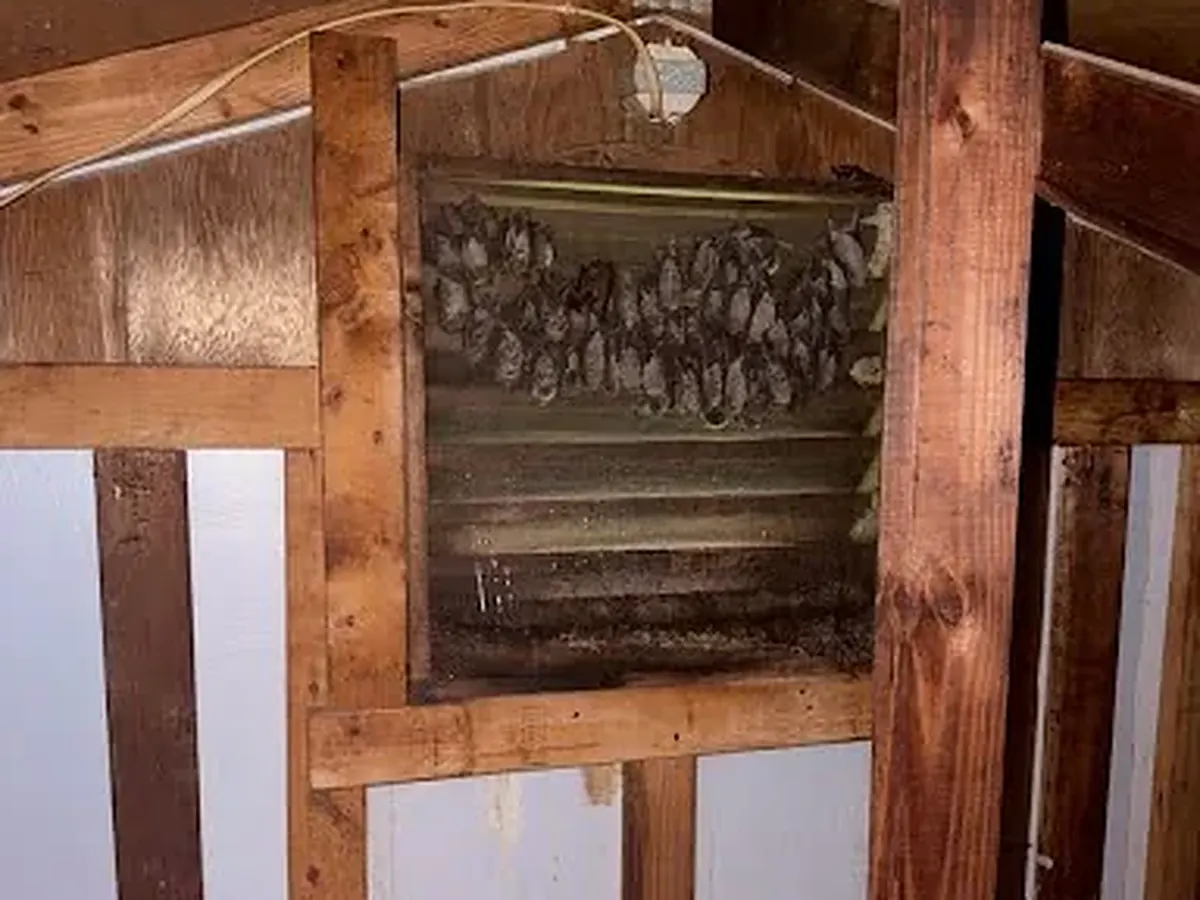
What kind of colony is in a house
The bats most likely to move into a Virginia building are the big brown bat, the evening bat and the little brown bat. Young are in the roost through the nursery season and can’t leave it until they can fly.
As fall arrives, most of these colonies move on, because attic temperatures swing too much for bats to hibernate there. The big brown bat can break that pattern and often winters in old buildings. A quiet attic in January is not proof that nothing is there.
What a colony does to an attic
Droppings pile up. A colony uses the same roost night after night, so guano collects in the same places on insulation, beams and the floor. Over a season or more, soiled insulation stops performing and holds odor.
Droppings can carry a fungus. A heavy buildup should be cleared by a professional crew; bats and disease covers the symptoms.
A bat can reach the living space. A loose attic hatch or an opening around a pipe is enough. If one turns up indoors, the bat in the house page tells you what to do.
Signs to look for between inspections
You don’t have to wait for the yearly check to notice trouble.
- Small dark droppings collecting in one spot on the attic floor, on insulation or on a windowsill under a gap
- A musty or ammonia-like smell in the attic or an upstairs room
- Light scratching, squeaking or fluttering in a wall or ceiling around dusk and dawn
- Dark smudges around a small hole at the roofline, a vent or the chimney
- Bats leaving the house at dusk
Any one of these is a reason to book an inspection rather than go up and look around yourself.
Homes that deserve a closer look
- Older homes. More trim joints, vents and patched spots where gaps can open.
- Homes near water. A house by a creek, a pond or Smith Mountain Lake sits close to good feeding grounds, since little brown bats hunt insect swarms over water.
- Homes that have had bats before. The house has already shown that bats can find a way in.
When to book it
An inspection can happen in any month, and a careful look doesn’t disturb a colony. Sealing is a separate matter and follows Virginia timing, which rules it out from May through August because flightless young may be inside. Booking the yearly check for early spring or fall lets a problem surface before the nursery season and leaves room to plan the work.
If the inspection does find bats, the stages that follow are in the bat exclusion walkthrough.
Questions we hear
How often should my attic be checked for bats?
Once a year makes sense. A house that has had bats before, or one with an older roof and many trim joints, can also be worth checking after a major storm.
What is the smallest gap a bat can use?
About a quarter inch, and anything that size or larger gets sealed. That’s why seams and trim joints get as much attention as obvious holes.
Is it safe to look in the attic myself?
A quick look from the hatch is fine. Don’t walk through droppings, stir them up or try to clean them; call a professional instead.
What does a yearly bat inspection cost?
It depends on the size of the house, how many rooflines it has and how easy the attic is to reach. The cost guide lists what moves the price on wildlife jobs, and a call to us covers what an inspection involves.
Request an inspection
Put your attic on a yearly schedule
Tell us about the house and what you have noticed. We help you work out when a bat check makes sense.