
Guide · By Zakk Moorman, Wildlife Biologist · Updated November 2026
Bats in a Smith Mountain Lake House: What to Check When You Open Up for the Season
You open the lake house for the season and find droppings on the deck, a sharp smell upstairs or scratching in the ceiling at dusk. A house that sits empty between visits gives bats a quiet roof with nobody around to hear them. Our home base in Hardy is close to Smith Mountain Lake, and Moorman’s Wildlife Management & Pest Control works on lake houses, cabins and guest cottages around the shoreline. Call (540) 494-8278 to have yours checked.
Why Bats Settle Near the Lake
The little brown bat often feeds over water, flying repeated paths through swarms of insects, and midges are a staple of its diet. The big brown bat, one of Virginia’s largest bats, does most of its feeding within about a mile of its roost. Smith Mountain Lake covers about 20,600 acres with homes along much of the water, so many roofs sit close to where these bats hunt. Both species often raise their young in buildings.
Telling bat species apart takes a close look, which matters for the timing rules below.
What to Check When You Open the House for the Season
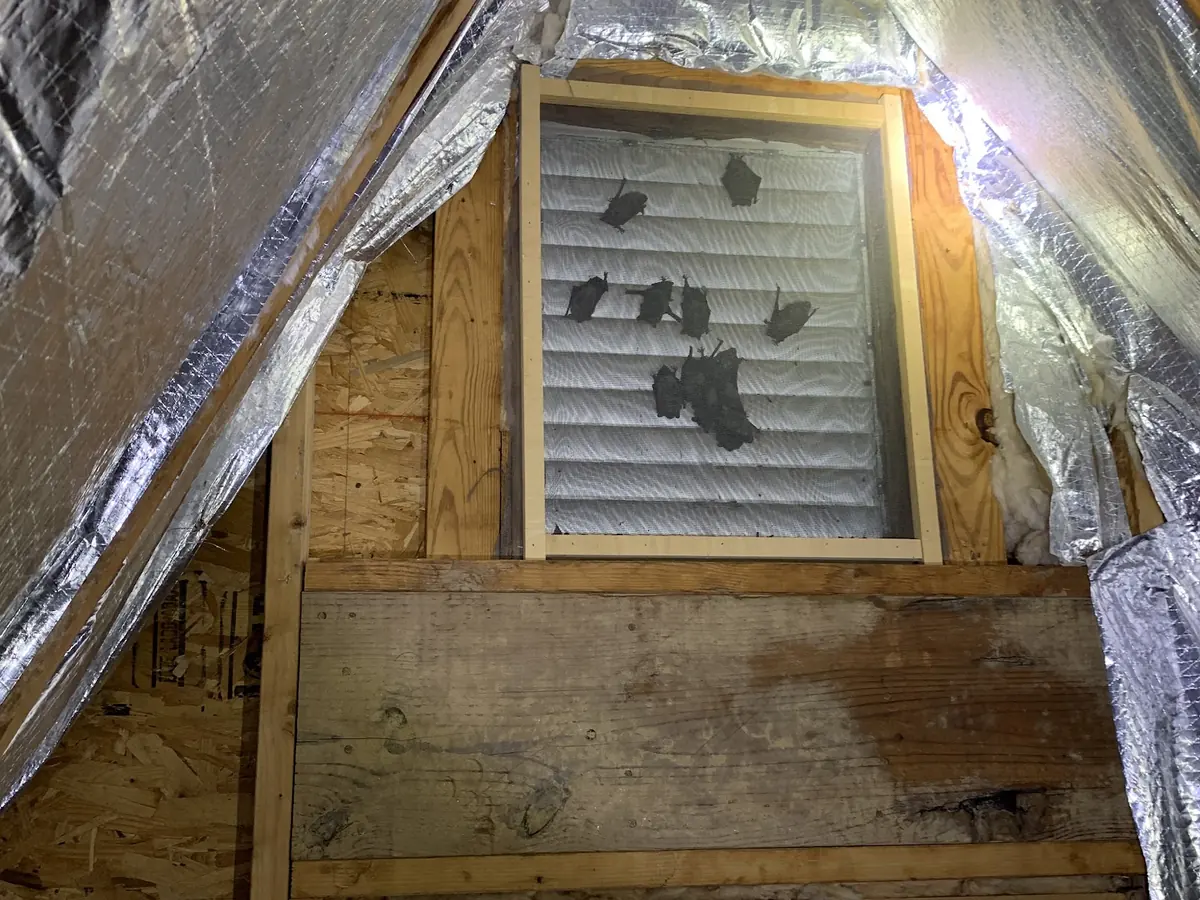
Start outside. The usual evidence is high-pitched clicks or scratching in walls and ceilings, droppings piling up in the same spot, a persistent odd smell, and dark smudges at roof overhangs, loose vents, flashing, louvers and eaves, where oils from bat fur rub off.
Bats leave at dusk, so the clearest way to locate an opening is to watch the outside of the house from dusk until roughly half an hour after sunset. Bats may use more than one exit, so post one watcher per side.
Stay out of the attic while you search.
Pascat photo request
A daylight photo of a lake cabin roofline or gable where bats enter, with the entry gap or stain marks visible.
When Bats Can Be Sealed Out
Virginia protects several bat species, so bat work follows state rules on timing and handling.
For lake cabins and boathouses, we follow Virginia wildlife rules on timing and avoid sealing out a colony from May through August, while flightless young may be present. Treat late spring and summer as a time for inspecting and planning, not sealing.
Come fall, most attic colonies move on to winter sites, because attic temperatures swing too much for hibernation.
A closed lake house is not automatically empty in winter.
Boathouses, Guest Cabins and Outbuildings
Lake properties often have more roofs than the main house. Treat each roofed structure as following the same calendar, and have an inspection check for a colony before anything is closed off.
In a log or timber cabin, finish the exclusion before you repair wood, insulation or trim, so the repairs are not torn open again.
How the Work Is Done
We are biologist-led, and the order of work is the same on any lake property: find the entry points, seal them after the bats have left, and repair the damage.
A one-way door lets bats leave but not get back in. It comes off only when every bat has left. Then the opening is sealed, with hardware cloth for large holes and louvered vents and caulk or foam for smaller gaps.
Droppings and damaged insulation are dealt with once the bats have left. To start, call (540) 494-8278 or use the online request form.
Questions we hear
What can I do in summer while bats can’t be sealed out?
Do not seal, stuff or screen openings yourself while a colony may have young. If bats keep reaching rooms where people sleep, call us and your local health department about options.
How small a gap can a bat use?
Bats can squeeze through very small gaps, so even a gap that looks too small to matter can be enough. Do not seal gaps yourself; sealing should wait until an inspection confirms the bats have left.
Should I put up a bat house?
It gives bats a place to roost elsewhere, but it supplements sealing and cannot replace it.
What if a bat is in a loft where guests sleep?
Treat it as a possible exposure. Health officials advise safely capturing the bat if possible, without touching it with bare hands, and calling your local health department at once.
For other animals at a lake property, see Smith Mountain Lake squirrel removal, raccoon removal and groundhog removal.
Request an inspection